
 EN


Introduction
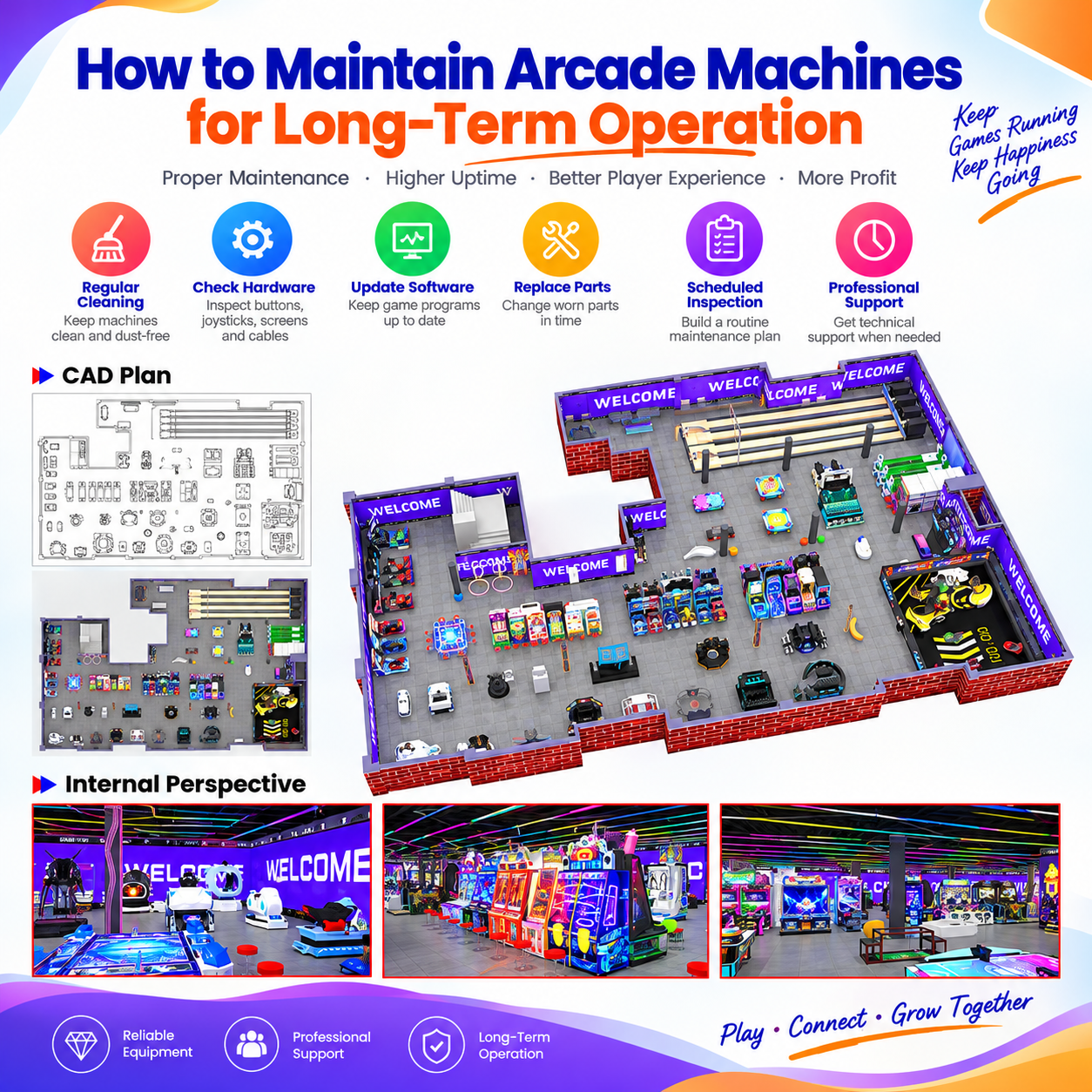
Running a successful arcade business involves much more than installing attractive gaming machines and welcoming customers. For family entertainment centers (FECs), shopping mall arcades, amusement parks, and other indoor entertainment venues, maintaining equipment reliability is essential for sustainable business operations.
Commercial arcade machines often operate for several hours every day, especially during weekends, holidays, and peak entertainment periods. Over time, frequent use can cause wear on buttons, joysticks, mechanical components, payment systems, and electronic parts.
Without proper maintenance, even high-quality arcade equipment may experience unexpected breakdowns, resulting in lost revenue opportunities, higher repair expenses, and dissatisfied customers.
Developing a preventive arcade machine maintenance plan helps operators identify problems early, improve equipment reliability, and extend the useful life of their investment.
This guide explains practical maintenance methods for commercial arcade machines and how entertainment operators can manage their equipment more effectively.
Why Is Arcade Machine Maintenance Important?
Arcade machines are commercial entertainment equipment designed for repeated public use. Unlike home gaming systems, they must withstand constant interaction from players of different ages.
Regular maintenance offers several important benefits.
Reduce Unexpected Downtime
When an arcade machine stops working, operators lose potential revenue during the repair period.
Routine inspections can identify worn buttons, loose connectors, and mechanical problems before they cause complete equipment failure.
Control Long-Term Operating Costs
Preventive maintenance often involves relatively simple tasks, including cleaning, checking connections, and replacing worn components.
Addressing these issues early may help operators avoid more extensive and expensive repairs.
Improve Customer Satisfaction
Players expect arcade machines to function correctly.
Unresponsive controls, inaccurate payment systems, or malfunctioning game mechanisms can create negative experiences and discourage repeat visits.
Reliable equipment contributes to a more enjoyable entertainment environment.
Protect Equipment Investment
Commercial arcade machines represent a significant investment for many entertainment businesses.
Proper maintenance helps preserve equipment condition, supports consistent operations, and may extend machine service life.
Establish a Daily Arcade Machine Inspection Routine
Daily inspections are among the simplest ways to improve equipment reliability.
Before opening your entertainment center, employees should briefly test the machines and check for visible damage.
Important inspection points include:
Test buttons, joysticks, steering wheels, and other player controls.
Confirm that screens display images correctly.
Check speakers and game sound.
Test coin acceptors, bill acceptors, or card payment systems.
Look for loose cabinet panels or exposed components.
Listen for unusual sounds during operation.
Confirm that ticket dispensers and prize mechanisms work properly.
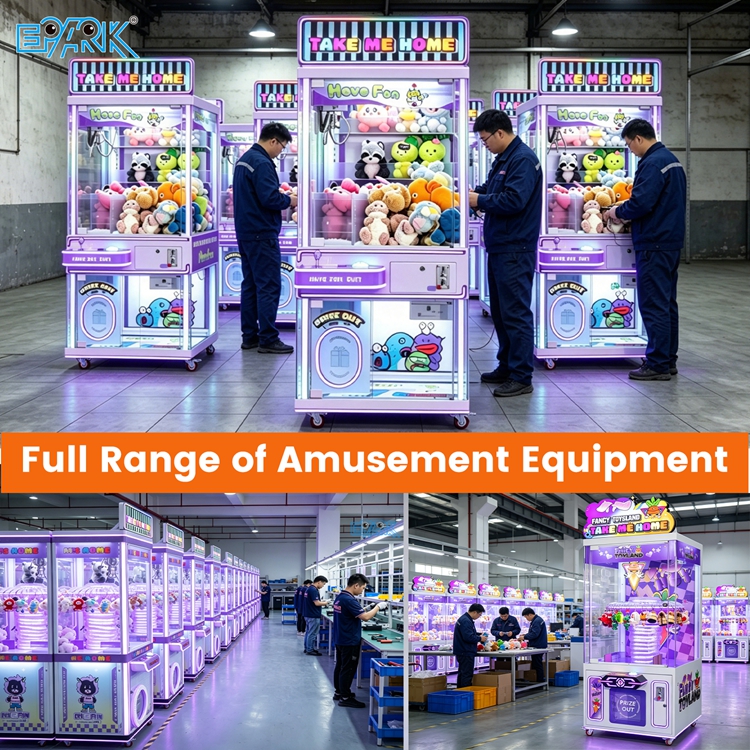
For claw machines, operators should also test the claw's movement, gripping mechanism, and prize delivery system.
For racing arcade machines, staff should inspect steering wheel response, pedals, seats, and other accessible moving components.
Recording inspection results allows operators to identify recurring issues and schedule maintenance before major problems develop.
Keep Arcade Machines Clean and Well Ventilated
Clean equipment creates a better impression and helps protect internal components.
Arcade machines are frequently touched by customers, particularly around control panels, buttons, joysticks, and touchscreens.
Dust accumulation can also affect ventilation and contribute to overheating.
Cleaning External Surfaces
Use suitable cleaning materials to remove fingerprints, dust, and dirt from machine cabinets and player controls.
When cleaning screens, choose products recommended for the display surface.
Avoid spraying liquids directly onto electronic components or allowing moisture to enter buttons, ventilation openings, and electrical connections.
Maintaining Internal Cleanliness
Dust may accumulate around cooling fans, power supplies, and ventilation openings.
Qualified maintenance personnel should inspect these areas periodically, following the manufacturer's instructions and electrical safety procedures.
Keeping ventilation paths unobstructed helps electronic components operate under appropriate conditions.
Maintain a Suitable Operating Environment
Indoor entertainment venues should pay attention to temperature, humidity, and air circulation.
Avoid placing arcade machines near water sources, in excessively humid areas, or where ventilation openings are blocked.
Appropriate environmental conditions can help reduce avoidable equipment problems.
Inspect Electrical Components and Power Systems
Electrical components play an essential role in arcade machine performance.
Commercial gaming equipment commonly includes power supplies, circuit boards, wiring harnesses, display systems, and electronic control modules.
Operators should watch for warning signs such as:
Unexpected machine shutdowns
Flickering or unstable displays
Intermittent button response
Repeated system restarts
Unusual electrical odors
Excessive heat around equipment
These symptoms may indicate electrical problems requiring professional inspection.
Staff should stop using equipment that shows potentially dangerous electrical faults and arrange an inspection by qualified technicians.
Before servicing internal components, technicians should follow appropriate power isolation procedures and manufacturer-specific safety instructions.
Using compatible electrical components and approved replacement parts is important for equipment safety and performance.
Maintain Mechanical Components and Moving Parts
Different arcade machine categories have different maintenance requirements.
Machines with frequently moving components generally require more mechanical attention than equipment with primarily electronic controls.
Claw Machine Maintenance
Claw machines contain motors, movement mechanisms, cables, sensors, and gripping assemblies.
Operators should regularly check:
Smooth claw movement
Cable and belt condition, where applicable
Claw opening and closing response
Prize detection or delivery mechanisms
Unusual vibration or mechanical noise
Claw settings should also be checked according to the machine's operating instructions.
Racing Arcade Machine Maintenance
Commercial racing games often feature steering wheels, pedals, seats, and sometimes motion systems.
Maintenance should focus on steering response, pedal sensitivity, mechanical stability, and accessible fastening points.
Any motion platform must be inspected according to the manufacturer's specific maintenance requirements.
Basketball Arcade Machine Maintenance
Basketball machines experience repeated ball impacts and frequent player interaction.
Operators should inspect the basket structure, scoring sensors, ball return path, and cabinet condition.
Maintaining accurate scoring helps prevent customer complaints.
Boxing Arcade Machine Maintenance
Boxing machines require periodic checks of impact surfaces, sensors, mounting structures, and mechanical assemblies.
Worn impact components should be replaced according to the manufacturer's instructions.
Check Payment and Redemption Systems
A reliable payment system is essential for arcade business operations.
If a machine fails to recognize coins, banknotes, or card payments, customers may abandon the game.
Operators should regularly test payment acceptance and confirm that credits are registered correctly.
Common maintenance tasks include checking coin acceptors for obstructions, inspecting card reader connections, and reviewing payment system error messages.
For redemption game machines, operators should also inspect ticket dispensers, ticket sensors, and prize delivery mechanisms.
Accurate ticket distribution is particularly important for maintaining customer trust.
Facilities using centralized arcade management systems should monitor machine-level payment and transaction reports to identify unusual patterns.
Create a Preventive Maintenance Schedule
Instead of waiting for equipment to fail, arcade operators should establish a structured maintenance schedule.
The actual maintenance frequency depends on equipment type, usage intensity, operating environment, and manufacturer recommendations.
The following schedule provides a practical starting point.
| Frequency | Recommended Maintenance Tasks |
|---|---|
| Daily | Test controls, displays, payment systems, and visible machine condition |
| Weekly | Clean cabinets, inspect accessible moving parts, check game functions |
| Monthly | Review error logs, inspect wear-prone components, test redemption mechanisms |
| Quarterly | Arrange more detailed inspections of mechanical and electrical systems |
| Annually | Review overall machine condition and plan component replacements or upgrades |
High-traffic entertainment centers may require more frequent inspections than smaller venues.
Operators should always prioritize the maintenance intervals specified in each machine's technical documentation.
Train Employees to Identify Common Problems
Effective arcade maintenance does not depend entirely on professional technicians.
Frontline employees can help identify problems before they become serious.
Staff should understand how to recognize common warning signs, report malfunctioning machines, and perform permitted basic inspections.
For example, employees may notice that a joystick responds slowly, a claw machine fails to release prizes properly, or a ticket dispenser frequently jams.
Providing a simple reporting procedure helps management respond quickly.
However, staff without appropriate technical qualifications should not perform internal electrical repairs or unsafe mechanical servicing.
Clear responsibilities improve maintenance efficiency and workplace safety.
Maintain an Inventory of Essential Spare Parts
For international arcade operators and equipment distributors, spare parts availability can influence repair time.
Waiting for an imported component may extend equipment downtime, especially when replacement parts require international shipping.
Keeping a small inventory of compatible, commonly needed components can simplify routine repairs.
Depending on the equipment, useful spare parts may include buttons, switches, sensors, wiring connectors, and other manufacturer-recommended consumable components.
Operators should identify critical spare parts when purchasing new machines and discuss replacement availability with their suppliers.
For distributors serving multiple entertainment venues, centralized spare parts management can also improve after-sales service efficiency.
Use Maintenance Records to Improve Business Performance
Maintenance records provide useful information about equipment condition and operational efficiency.
Operators can track repair dates, component replacements, recurring faults, technician visits, and machine downtime.
These records help identify equipment that requires unusually frequent maintenance.
They can also support decisions about whether to repair, upgrade, relocate, or replace a machine.
For example, a machine experiencing repeated breakdowns may require a more comprehensive inspection rather than another temporary repair.
Combining maintenance records with machine revenue data provides additional insight into equipment performance.
A machine with strong customer demand and manageable maintenance expenses may justify continued investment, while an older machine with recurring failures may need replacement.
Choose an Arcade Machine Manufacturer With Reliable Support
Maintenance planning begins before equipment arrives at an entertainment center.
Choosing a dependable arcade machine manufacturer can make long-term operations easier.
When evaluating suppliers, buyers should consider product construction, technical documentation, spare parts availability, warranty terms, and after-sales assistance.
Manufacturers with production and quality control capabilities can also provide useful guidance on equipment configuration and operation.
How EPARK Supports Arcade Operators
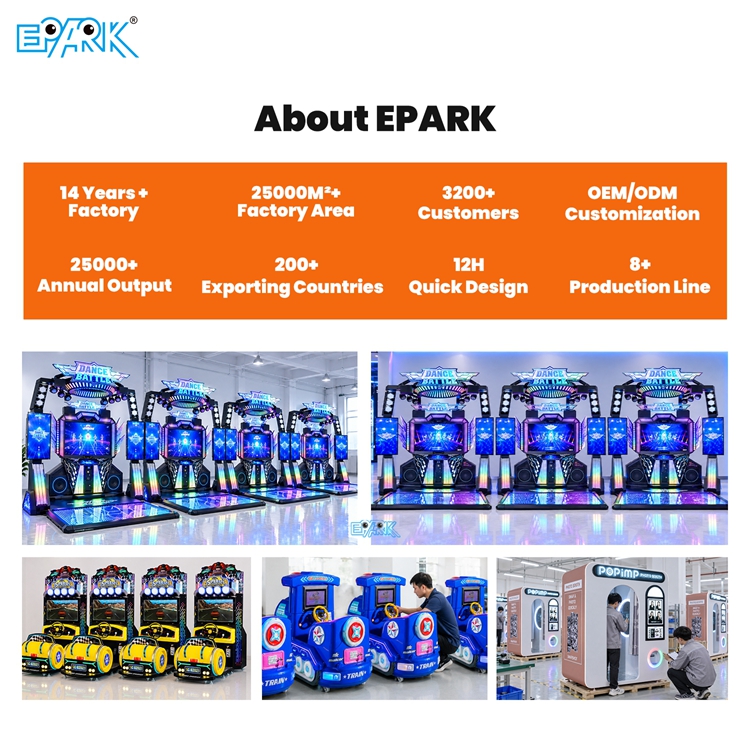
EPARK is a professional arcade game machine manufacturer based in Guangzhou, China, with over 14 years of industry experience.
Our product portfolio includes:
Claw machines and prize games
Commercial racing arcade machines
Basketball and boxing arcade games
Shooting and redemption game machines
VR entertainment equipment
Indoor playground and FEC equipment
EPARK provides equipment customization, project planning assistance, quality inspection, and technical after-sales support.
For international customers, we also offer remote technical guidance and spare parts assistance to help operators manage their equipment.
Working with an experienced manufacturer allows entertainment investors and distributors to consider not only the initial purchase but also the long-term operation of their arcade equipment.
Frequently Asked Questions
1. How Often Should Commercial Arcade Machines Be Maintained?
Arcade machines should receive basic visual and functional inspections daily, with more detailed maintenance performed according to equipment usage and manufacturer recommendations.
Machines with moving mechanisms or heavy customer traffic may require additional inspections.
2. What Are the Most Common Arcade Machine Maintenance Problems?
Common issues include worn buttons, unresponsive joysticks, payment system faults, ticket dispenser jams, mechanical wear, and display problems.
Regular inspections and timely component replacement can help prevent minor issues from developing into more serious failures.
3. What Should Buyers Check About Maintenance Before Importing Arcade Machines?
International buyers should ask suppliers about maintenance instructions, warranty coverage, compatible spare parts, technical support, and replacement component availability.
These factors are particularly important for distributors and FEC operators managing equipment over long periods.
Conclusion
Maintaining arcade machines is an important responsibility for every entertainment business operator.
Daily inspections, regular cleaning, mechanical maintenance, electrical safety checks, employee training, and spare parts management all contribute to more dependable equipment operation.
A preventive maintenance strategy can help reduce downtime, control avoidable repair expenses, and improve the customer experience.
For arcade distributors, FEC operators, and entertainment investors, selecting equipment with reliable manufacturer support is equally important.
Looking for commercial arcade machines and professional entertainment equipment solutions?
Visit EPARK Game Machine Factory to explore our arcade equipment range and contact our team for product information, customization options, and project assistance.
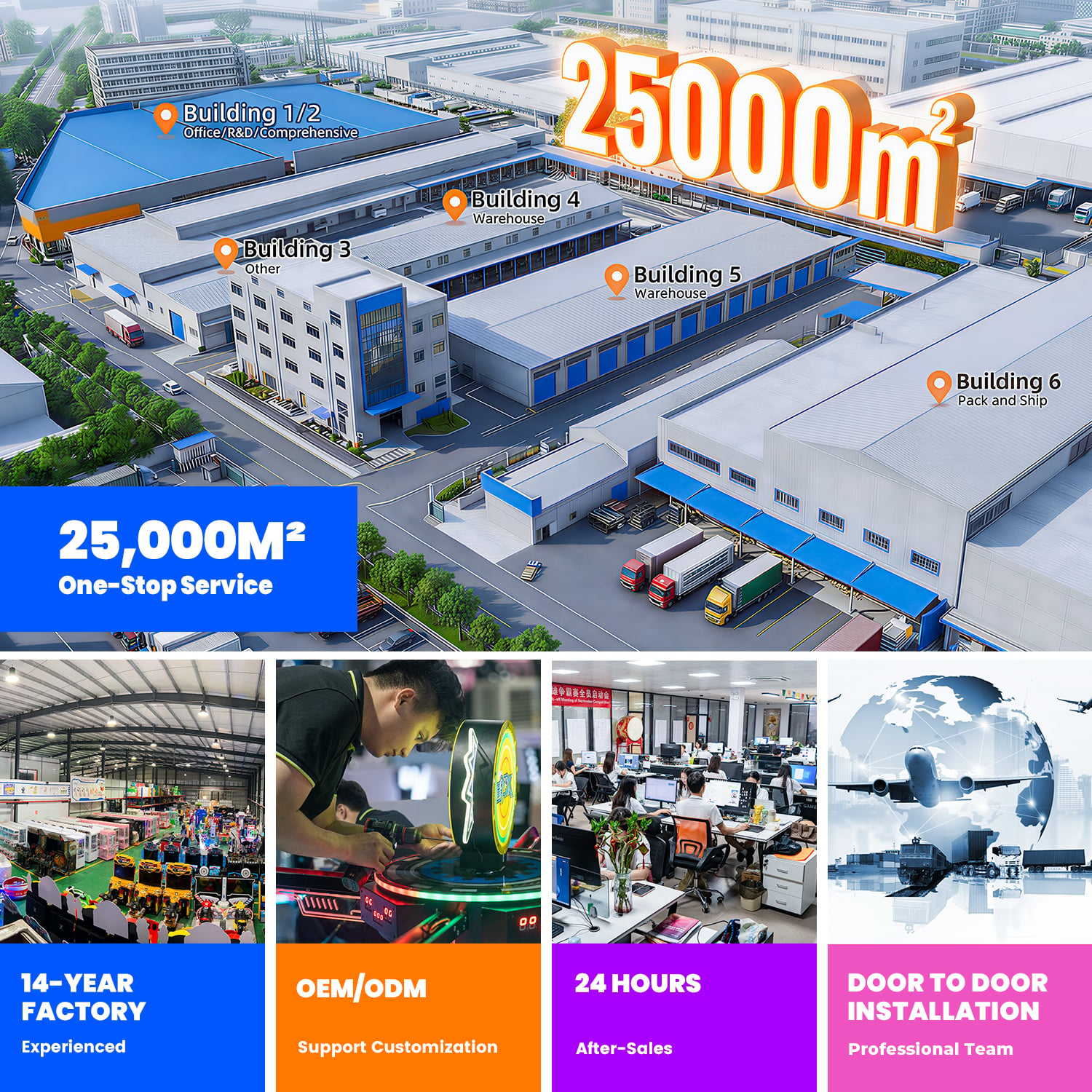
Table of Contents
- Introduction
- Why Is Arcade Machine Maintenance Important?
- Establish a Daily Arcade Machine Inspection Routine
- Keep Arcade Machines Clean and Well Ventilated
- Inspect Electrical Components and Power Systems
- Maintain Mechanical Components and Moving Parts
- Check Payment and Redemption Systems
- Create a Preventive Maintenance Schedule
- Train Employees to Identify Common Problems
- Maintain an Inventory of Essential Spare Parts
- Use Maintenance Records to Improve Business Performance
- Choose an Arcade Machine Manufacturer With Reliable Support
- How EPARK Supports Arcade Operators
- Frequently Asked Questions
- Conclusion