
 EN


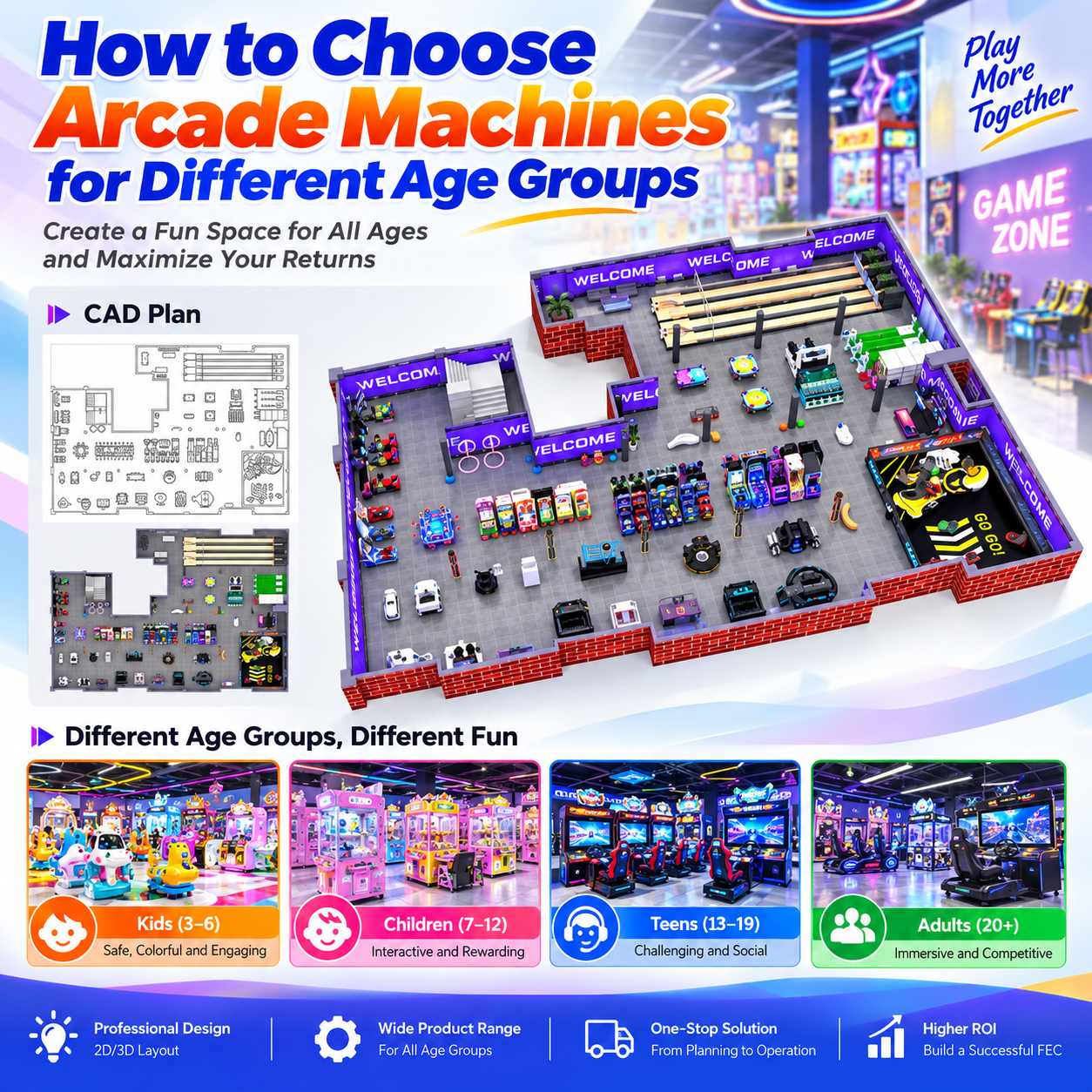
How to Choose Arcade Machines for Different Age Groups
Choosing the right arcade machines is one of the most important decisions when planning a family entertainment center (FEC), commercial arcade, or indoor amusement venue. Different age groups have different entertainment preferences, physical abilities, and expectations.
A machine that attracts young children may not appeal to teenagers, while highly competitive games may be unsuitable for younger visitors.
For arcade operators and entertainment investors, understanding these differences can help create a more balanced equipment selection, improve customer experiences, and support long-term business performance.
In this guide, we explore how to choose commercial arcade machines for different age groups and how to develop an equipment mix that fits your target audience.
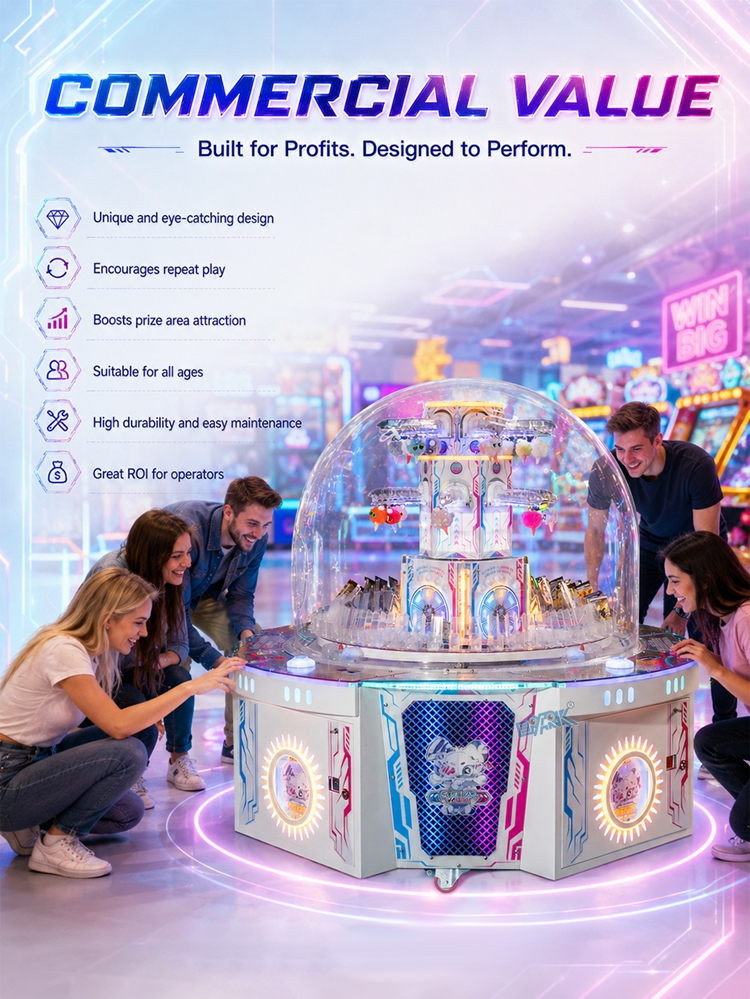
Why Age-Based Arcade Machine Selection Matters
Successful entertainment centers do not necessarily need the largest number of machines. They need the right combination of attractions for their customers.
Before purchasing equipment, operators should understand the demographics of their target market.
A family-focused shopping mall entertainment center may attract parents with young children, while an arcade near a university may attract more teenagers and young adults.
Selecting equipment based on customer characteristics offers several advantages.
Better Customer Engagement
Age-appropriate games encourage visitors to participate because they match their interests, abilities, and preferred levels of challenge.
More Balanced Entertainment Options
A diverse selection gives families and groups more opportunities to enjoy activities together.
More Efficient Space Utilization
Understanding the target audience helps operators avoid installing machines that receive limited attention.
Stronger Repeat-Visit Potential
Customers are more likely to return when an entertainment venue offers enjoyable and varied experiences.
However, age should be treated as one planning factor rather than a strict rule. Local preferences, venue positioning, accessibility, and individual interests are equally important.
1. Arcade Machines for Young Children
Young children generally benefit from entertainment equipment featuring intuitive controls, engaging visuals, and gameplay appropriate to their developmental abilities.
For family entertainment centers serving parents with younger children, suitable attractions may include kiddie rides, simple interactive games, and selected prize machines.
Kiddie Rides
Kiddie rides are common attractions in shopping malls, family entertainment centers, and indoor amusement venues.
Depending on the model, they may feature gentle movement, colorful themes, music, and simple interactive functions.
Popular categories include:
Car-themed kiddie rides
Animal-themed rides
Mini carousel machines
Small train rides
Rocking rides
Operators should always check the manufacturer's intended user age, supervision requirements, capacity, and safety instructions.
Simple Interactive Arcade Games
Games with straightforward controls and easily understood objectives can be attractive to younger visitors.
Examples include selected ball-tossing games, simple redemption games, and interactive amusement equipment designed for children.
Equipment should be selected according to its stated age suitability and operating requirements.
Mini Claw Machines
Some compact claw machines are designed with accessible controls and colorful prize displays.
These machines may appeal to families, particularly when prizes are appropriate for the intended audience.
Operators should consider control height, game difficulty, prize size, and applicable safety requirements.
2. Arcade Machines for School-Age Children
School-age children often enjoy games involving coordination, skill development, competition, and visible achievements.
They may prefer interactive machines with clear objectives and scoring systems.
Basketball Arcade Machines
Basketball arcade games encourage players to aim, throw, and improve their scores.
They are frequently used in family entertainment centers because of their recognizable gameplay and competitive appeal.
Operators can select suitable models based on machine dimensions, player accessibility, and venue requirements.
Air Hockey Tables
Air hockey offers fast-paced competition between players.
Its straightforward rules make it accessible to a broad audience, although appropriate table sizes and safety supervision should be considered.
Two-player and four-player configurations provide different entertainment experiences.
Redemption Game Machines
Redemption games allow players to participate in skill-based or interactive challenges and, where configured, collect tickets or points.
Examples include ball games, reaction games, and selected target-based entertainment machines.
A well-organized redemption area can encourage customers to explore multiple attractions.
Operators should ensure that game instructions, prize systems, and equipment design suit the intended users.
3. Arcade Machines for Teenagers
Teenagers may be attracted to games offering competition, immersive visuals, multiplayer participation, and opportunities to demonstrate skill.
For entertainment centers targeting teenage customers, racing simulators, rhythm games, sports challenges, and selected shooting arcade games may be worth considering.
Racing Arcade Machines
Racing machines provide competitive driving experiences through steering controls, pedals, visual effects, and game challenges.
Some commercial models include large screens, connected multiplayer functions, or motion features.
These attractions can work well in arcades seeking a dynamic gaming environment.
Shooting Arcade Games
Shooting arcade machines are popular in many commercial entertainment venues.
Depending on the model, they may feature interactive missions, cooperative modes, or competitive gameplay.
Operators should select content that is appropriate for their target audience and local market requirements.
Rhythm and Reaction Games
Rhythm-based and reaction games challenge players through timing, coordination, or movement.
Their interactive nature can create engaging entertainment experiences for individuals and groups.
For operators, these games may add useful variety alongside racing and sports machines.
4. Arcade Machines for Adults
Adult visitors may prefer competitive games, nostalgic arcade experiences, social entertainment, or attractions offering greater challenges.
Adult-focused arcade areas can also serve groups of friends, corporate events, and social entertainment activities.
Competitive Sports Arcade Machines
Basketball machines, boxing machines, and air hockey tables can encourage friendly competition.
Clear scoring systems make these games suitable for casual challenges between friends.
Racing Simulators
Commercial racing simulators can appeal to adults interested in driving experiences and competitive gameplay.
Models featuring larger displays, detailed controls, and additional feedback systems may offer a more immersive experience.
Classic Arcade and Skill Games
Traditional arcade formats and skill-based games may attract players who enjoy familiar gameplay.
A balanced selection of classic and modern attractions can help venues serve customers with different preferences.
5. Choose Multiplayer Games for Family and Group Entertainment
Age-specific equipment is useful, but many successful FECs also benefit from games that bring different visitors together.
Multiplayer attractions can encourage families, friends, and groups to participate in shared activities.
Common options include:
Two-player racing machines
Four-player air hockey tables
Multiplayer basketball machines
Cooperative arcade games
Group-oriented interactive attractions
When choosing multiplayer machines, operators should evaluate the number of players, required space, viewing areas, and surrounding circulation.
The goal is to make games enjoyable not only for participants but also for accompanying visitors.
6. Balance Your Arcade Game Mix
A successful arcade equipment selection should reflect actual customer demand rather than relying on a fixed percentage for every game category.
For example, a shopping mall FEC serving families may require a different combination of machines from a gaming venue targeting young adults.
The following table provides a general planning reference.
| Target Audience | Suitable Game Categories | Main Entertainment Appeal |
|---|---|---|
| Young children | Kiddie rides, simple interactive games, suitable mini claw machines | Accessible and engaging play |
| School-age children | Basketball, air hockey, redemption games | Skills and friendly competition |
| Teenagers | Racing, shooting, rhythm, reaction games | Challenge and multiplayer gameplay |
| Adults | Racing simulators, sports games, classic arcade games | Competition and social entertainment |
| Families and groups | Multiplayer racing, air hockey, cooperative games | Shared experiences |
Operators should use this information as a starting point and adjust equipment selection according to actual market research.
7. Consider Floor Space and Machine Placement
Selecting suitable equipment also involves understanding the physical limitations of the venue.
Different arcade machines require different installation areas and operating clearances.
For example, racing simulators may need additional space for seating and player access, while air hockey tables require sufficient clearance around the playing surface.
Before confirming an order, operators should review:
Total usable floor area
Machine dimensions
Player access and movement
Entrances and exits
Electrical requirements
Maintenance access
Prize counter locations
Applicable safety and accessibility requirements
Machine placement should support convenient circulation while allowing customers to move comfortably between attractions.
For venues with limited space, compact game machines and carefully planned layouts may provide more flexibility.
8. Evaluate Game Popularity and Operating Costs
Equipment selection should balance entertainment appeal with commercial practicality.
A visually impressive machine is not necessarily the best investment for every arcade.
Operators should consider the purchase price, installation requirements, energy consumption, maintenance needs, and expected customer demand.
Understand Local Entertainment Preferences
Customer preferences vary by market.
Researching nearby entertainment venues, local demographics, and customer behavior can help identify suitable equipment categories.
Consider Maintenance Requirements
Machines with mechanical movement may require different maintenance resources from simpler electronic games.
Operators should request maintenance instructions and spare parts information before purchasing.
Evaluate Revenue Potential
Projected machine revenue should be assessed using realistic assumptions about pricing, operating hours, utilization, and expenses.
Return on investment is not guaranteed and depends on actual venue performance.
9. Plan for Future Equipment Updates
Customer preferences and entertainment trends can change over time.
An arcade that attracts customers today may need new attractions in the future to maintain interest.
Instead of filling every available area immediately, operators can consider allowing flexibility for future equipment changes.
This may involve rotating selected machines, introducing new game categories, or updating attractions based on customer feedback.
Tracking machine performance also helps operators identify which equipment should be retained, relocated, or replaced.
A flexible equipment strategy supports long-term venue development.
10. Work With an Experienced Arcade Machine Manufacturer
For international arcade investors and distributors, choosing the right manufacturer can simplify equipment selection and project planning.
A professional supplier should be able to explain product applications, technical specifications, installation requirements, customization options, and after-sales services.
How EPARK Supports Your Arcade Project
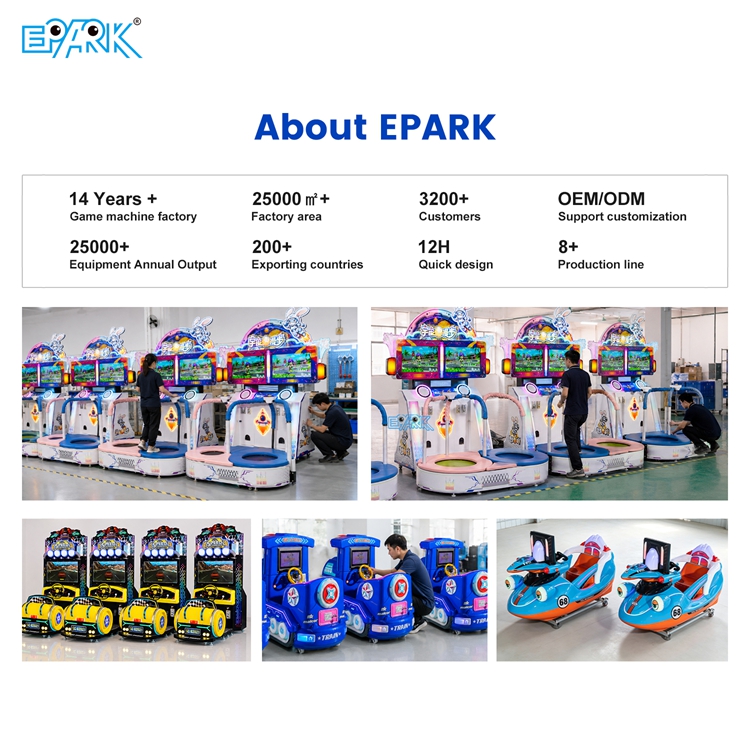
EPARK is a professional amusement equipment manufacturer based in Guangzhou, China, with over 14 years of manufacturing experience.
With a 25,000-square-meter manufacturing facility and a 3,000-square-meter showroom, EPARK offers a wide range of commercial entertainment equipment.
Our product categories include:
Claw machines and prize machines
Racing arcade machines
Shooting arcade machines
Redemption game machines
Basketball and boxing machines
Air hockey tables
VR entertainment equipment
Kiddie rides
Indoor playground equipment
EPARK provides one-stop FEC solutions, including equipment selection, venue layout planning, product customization, production, quality inspection, and after-sales assistance.
For buyers serving different age groups, our team can help review equipment options based on venue size, target customers, budget, and project requirements.
Frequently Asked Questions
1. What Arcade Machines Are Suitable for Family Entertainment Centers?
Family entertainment centers often benefit from a combination of age-appropriate kiddie rides, redemption games, sports arcade machines, claw machines, and multiplayer attractions.
The best combination depends on customer demographics, venue size, and local demand.
2. How Many Types of Arcade Machines Should a New Arcade Include?
There is no universal number of game categories suitable for every arcade.
Operators should evaluate available floor space, investment budget, customer preferences, and expected demand before selecting equipment.
A balanced mix of different gameplay experiences is generally more useful than purchasing many similar machines without considering customer interests.
3. How Can Arcade Owners Choose Machines That Attract More Customers?
Arcade owners should research their target audience, analyze local competitors, and evaluate the gameplay appeal of each equipment category.
They should also consider multiplayer experiences, machine placement, maintenance requirements, and future equipment updates.
Conclusion
Choosing arcade machines for different age groups is an important part of developing a successful entertainment business.
Young children, school-age visitors, teenagers, and adults may have different entertainment preferences, but the most effective venues offer a thoughtful combination of attractions that encourages enjoyable experiences.
By understanding customer demographics, selecting suitable equipment, planning efficient layouts, and evaluating operating costs, arcade owners can make more informed investment decisions.
For FEC operators, distributors, and entertainment investors, working with an experienced manufacturer can also simplify the process of planning and purchasing commercial arcade equipment.
Planning to open or upgrade an arcade or family entertainment center?
Visit EPARK Game Machine Factory to explore commercial arcade machines and one-stop entertainment project solutions.
Contact our team for equipment recommendations, product catalogs, and project quotations.
Table of Contents
- How to Choose Arcade Machines for Different Age Groups
- Why Age-Based Arcade Machine Selection Matters
- 1. Arcade Machines for Young Children
- 2. Arcade Machines for School-Age Children
- 3. Arcade Machines for Teenagers
- 4. Arcade Machines for Adults
- 5. Choose Multiplayer Games for Family and Group Entertainment
- 6. Balance Your Arcade Game Mix
- 7. Consider Floor Space and Machine Placement
- 8. Evaluate Game Popularity and Operating Costs
- 9. Plan for Future Equipment Updates
- 10. Work With an Experienced Arcade Machine Manufacturer
- Frequently Asked Questions
- Conclusion