
 EN


Introduction
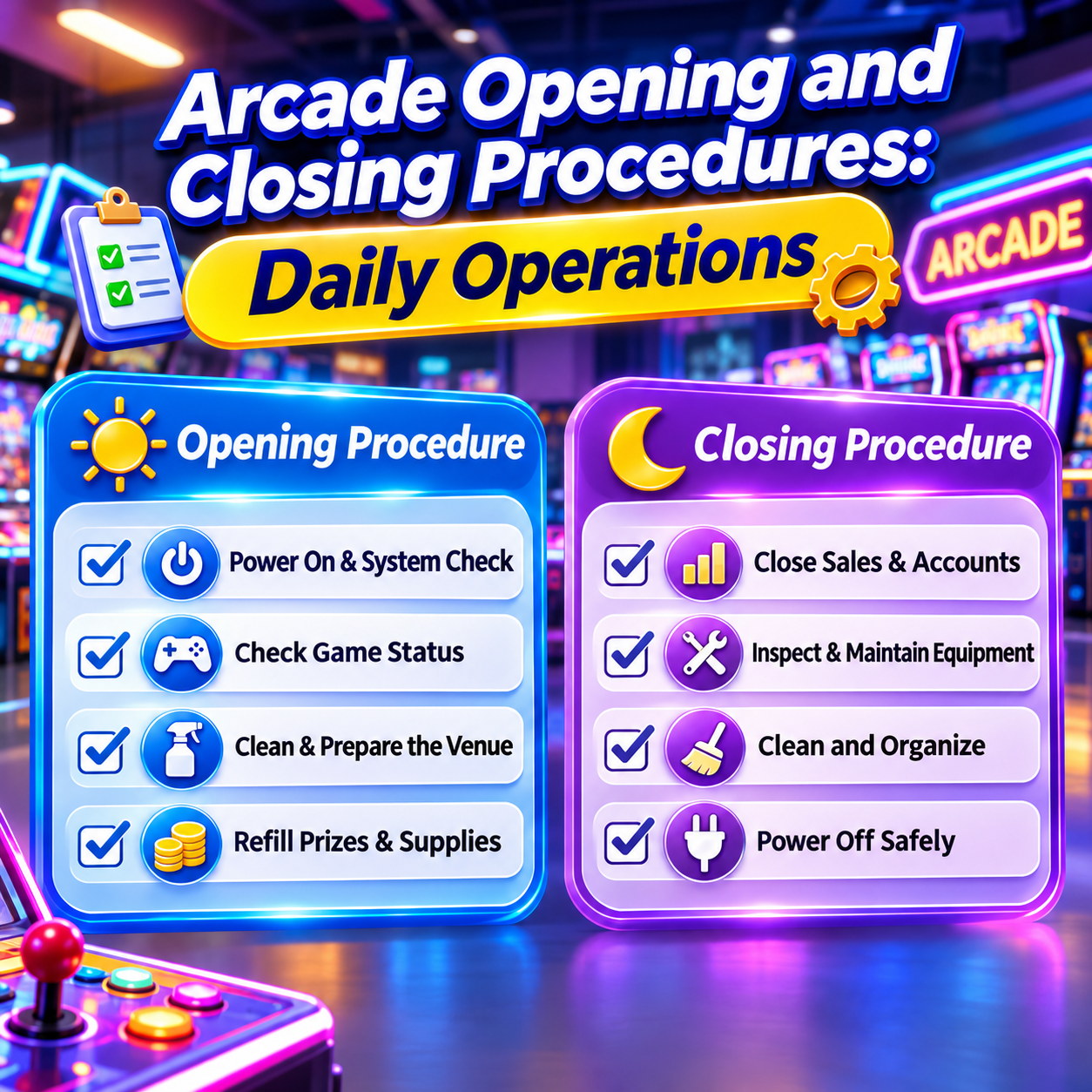
Running a commercial arcade or family entertainment center (FEC) requires consistent daily management. While game selection and customer service are important, the procedures employees follow before opening and after closing can also influence equipment reliability, operational efficiency, and customer satisfaction.
An arcade may contain dozens of different machines, including racing simulators, claw machines, redemption games, basketball machines, and VR attractions. Each category has specific operating requirements that employees need to understand.
Without standardized opening and closing procedures, businesses may experience missed equipment faults, inaccurate transaction records, delayed opening times, and unnecessary maintenance expenses.
Establishing a clear arcade operations checklist helps employees complete essential tasks consistently and allows managers to monitor daily performance more effectively.
This guide explains how commercial arcade operators can organize opening inspections, equipment preparation, payment reconciliation, and end-of-day procedures.
Why Arcade Opening and Closing Procedures Matter
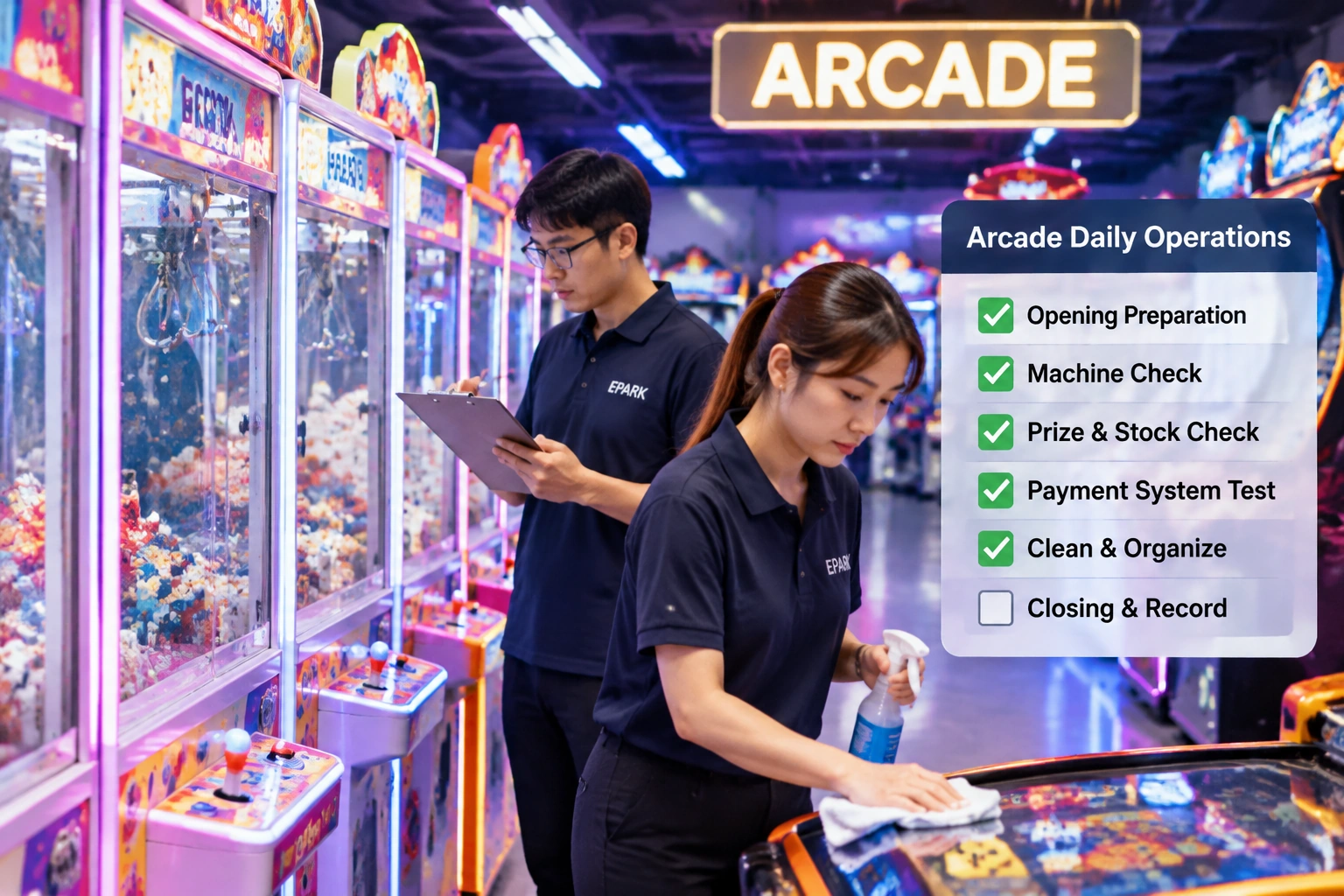
Opening and closing routines create a structured foundation for daily arcade management.
Rather than relying on individual employees to remember every task, operators can establish standard operating procedures that apply across different shifts and locations.
Consistent procedures help identify equipment problems before customers arrive, maintain accurate business records, and ensure that the venue is ready for operation.
For businesses managing multiple entertainment centers, standardized routines also make employee training and performance monitoring easier.
An effective checklist should be practical, easy to follow, and adjusted according to the machines installed in the venue.
Prepare the Venue Before Opening
Before switching on arcade machines, employees should inspect the general condition of the entertainment area.
Walk through the venue and look for obstacles, spills, damaged flooring, or other conditions that could affect customer movement.
Check that entrances, exits, and required circulation routes remain unobstructed.
Staff should also confirm that lighting, ventilation, and other building systems are operating as expected.
For family-oriented venues, inspect children's activity areas and ensure that any age-specific equipment is ready for supervised use where required.
Any potentially unsafe condition should be reported and addressed before the affected area opens.
Start Arcade Machines Using Approved Procedures
Commercial arcade machines may have different startup requirements.
Some machines can be started through a standard power switch, while others may require a specific sequence involving control systems, computers, or connected accessories.
Employees should follow the manufacturer's operating instructions for each model.
After startup, confirm that the machine completes its normal initialization process.
Check displays, lighting, sound, and control responses.
If an error message appears or the machine behaves unexpectedly, record the problem and notify the responsible technician or manager.
Avoid repeatedly restarting malfunctioning equipment without understanding the cause.
Perform Functional Checks on Different Game Categories
Different arcade machine categories require different daily checks.
A general inspection is useful, but equipment-specific testing helps identify problems that might otherwise be overlooked.
Claw Machines
Check joystick response, claw movement, prize visibility, and the prize delivery opening.
Confirm that the machine registers game credits correctly and operates according to its configured settings.
Racing Arcade Machines
Inspect steering wheels, pedals, seats, and display systems.
Where applicable, test multiplayer connections and motion features according to the manufacturer's instructions.
Basketball Arcade Machines
Check scoring sensors, basket structures, ball return paths, and the condition of the basketballs.
Ensure that the machine registers scores accurately during a brief test.
Redemption Game Machines
Confirm that ticket dispensers, sensors, and reward mechanisms function correctly.
For machines connected to a centralized redemption system, check the relevant communication status.
VR Entertainment Equipment
Inspect headsets, controllers, straps, and accessible cables.
Check that the play area is clear and that any required supervision and safety procedures are in place.
Check Payment Systems Before Customers Arrive
Payment system problems can delay gameplay even when the machines themselves operate correctly.
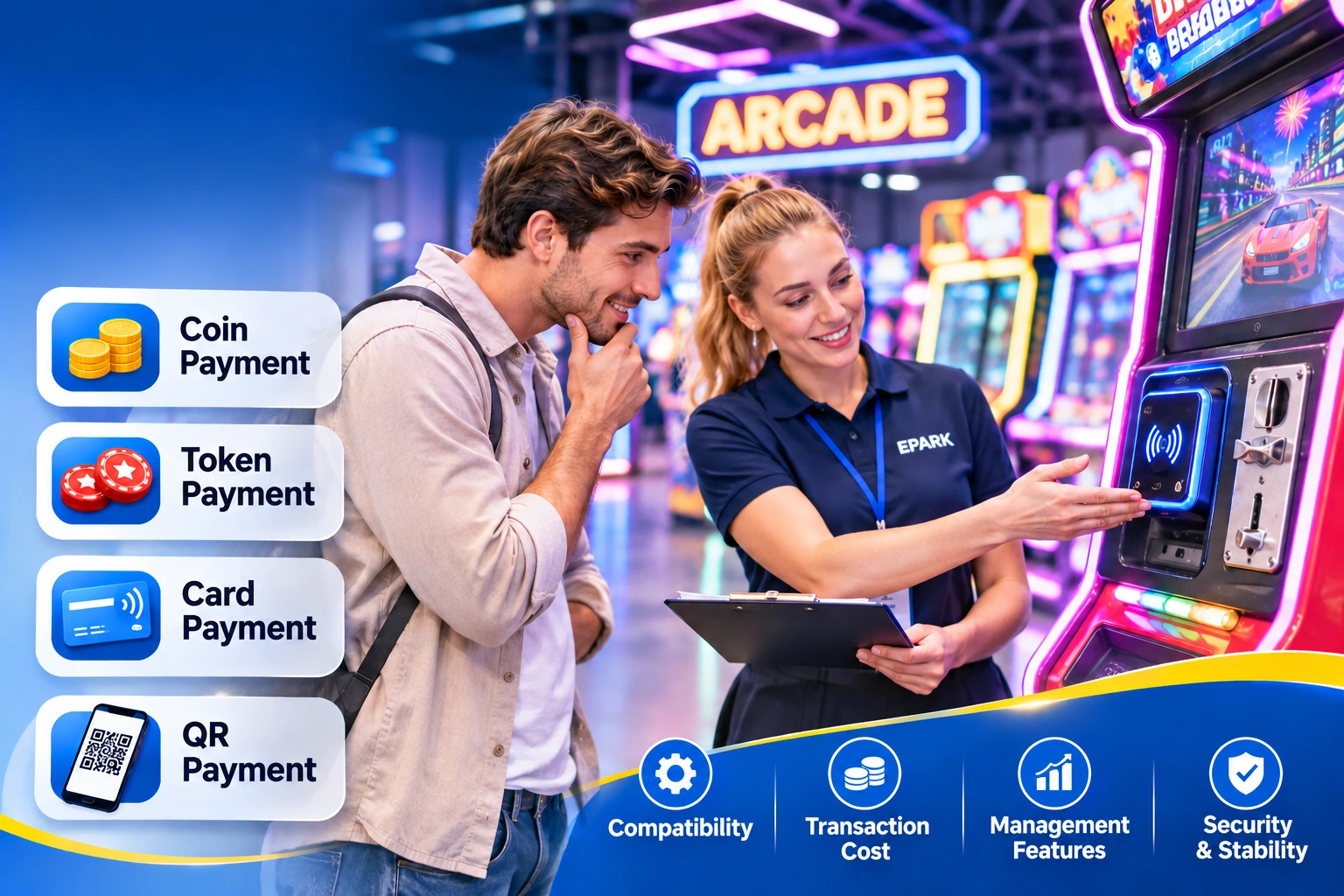
Before opening, test the payment methods used in the venue.
For coin-operated machines, check that coin acceptors recognize valid coins or tokens.
For cashless systems, verify that card readers, recharge terminals, and management software are functioning.
If the venue uses multiple payment methods, confirm that each supported option registers credits correctly.
Employees should also know how to respond when a customer reports a payment problem.
Testing payment functions before opening helps reduce avoidable interruptions during busy periods.
Prepare Prize Redemption and Claw Machine Areas
Prize management is another important opening task.
For redemption counters, check that available prizes are organized and that ticket or point requirements are clearly displayed.
Confirm that popular rewards are sufficiently stocked for expected customer demand.
For claw machines, inspect prize arrangements and ensure that merchandise does not interfere with the equipment's operating mechanism.
Damaged or unsuitable prizes should be removed.
Operators should also verify that redemption records and inventory systems are ready for daily use.
An organized prize area can improve customer convenience and simplify staff responsibilities.
Assign Staff Responsibilities Before Opening
A short team briefing can help employees prepare for the operating day.
Managers should confirm staff assignments, expected customer traffic, scheduled events, and any equipment that remains unavailable.
Employees should understand who is responsible for customer assistance, machine monitoring, cleaning, prize redemption, and technical issue reporting.
For larger FECs, different employees may be assigned to specific entertainment zones.
Clear communication helps prevent important tasks from being overlooked.
Monitor Equipment Throughout the Day
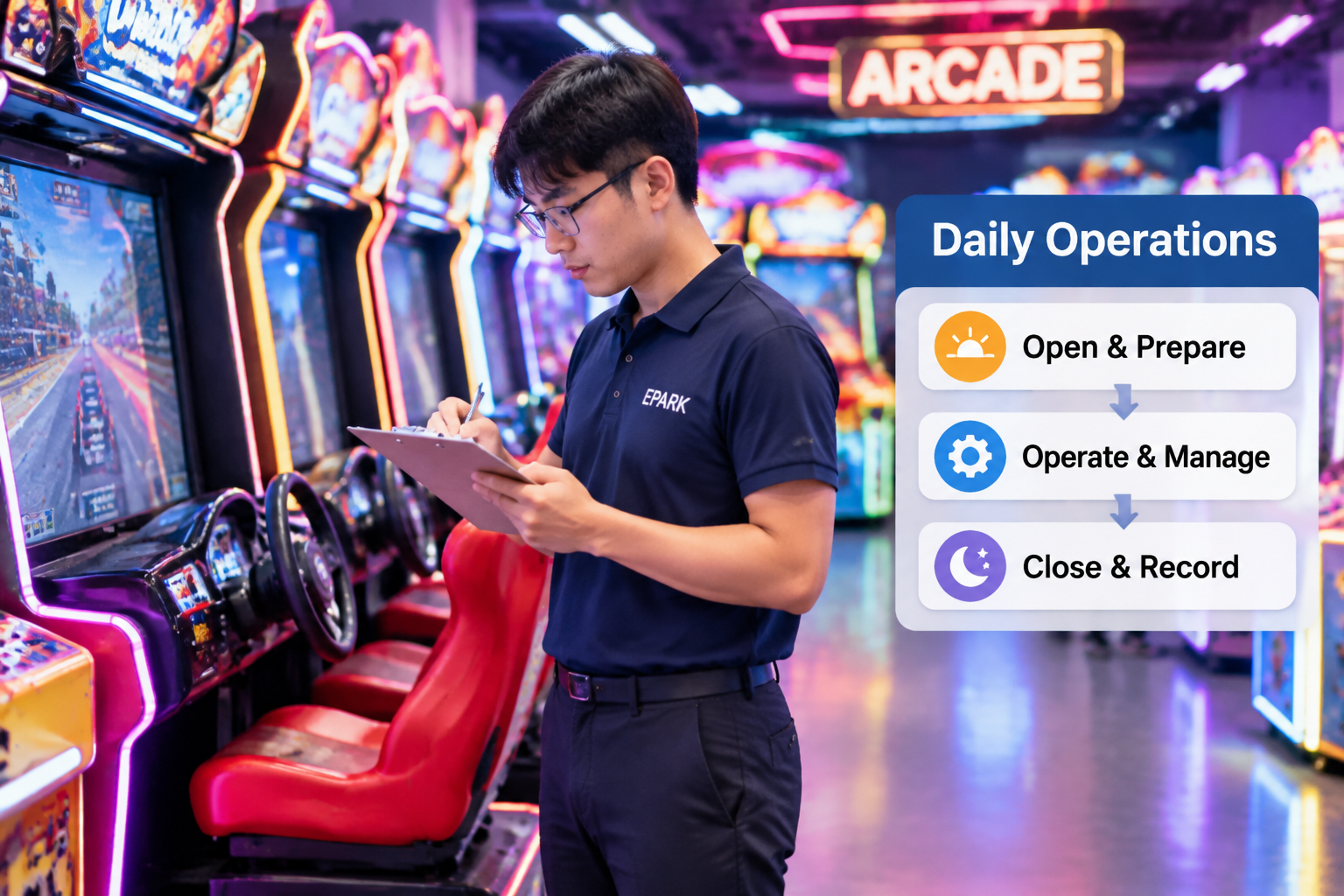
Opening inspections are only the beginning of daily arcade management.
During operating hours, employees should continue monitoring machine performance and customer areas.
Common issues include payment errors, unresponsive controls, ticket jams, and damaged accessories.
Staff should record faults and prevent customers from using equipment that may be unsafe.
Cleaning schedules should also be maintained, particularly around frequently touched surfaces and busy gaming areas.
Managers can review machine availability and customer feedback to identify recurring problems.
Begin Closing Procedures With Customer Communication
Closing procedures should begin before the venue's official closing time.
Employees can inform customers of the remaining operating period and explain any relevant rules for completing games or redeeming prizes.
For attractions with longer sessions, such as selected VR experiences, staff should avoid starting sessions that cannot be completed within the permitted operating period.
Customer communication should remain polite and consistent.
Where applicable, closing announcements should also consider customers with accessibility or communication needs.
Shut Down Arcade Machines Correctly
After customers have finished playing, employees should shut down equipment according to the manufacturer's instructions.
Some machines require software shutdown procedures before power is disconnected.
Others may have separate controls for displays, computers, lighting, or motion systems.
Improper shutdown procedures can sometimes cause software errors or interrupt system processes.
Employees should not disconnect power abruptly unless required by an approved emergency procedure.
For connected machines, confirm that relevant transaction or operational data has been saved where necessary.
Reconcile Payments and Daily Transactions
Accurate financial records are an important part of closing procedures.
For coin-operated venues, authorized employees should collect and record cash or tokens according to established controls.
For cashless systems, managers may review transaction reports, recharge activity, and machine-level revenue records.
Compare available records and investigate significant discrepancies.
Where practical, separate cash handling, verification, and approval responsibilities to reduce errors.
Financial procedures should follow the business's accounting policies and applicable regulations.
Review Prize Inventory and Redemption Records
At closing, employees should review prize stock and redemption activity.
Record items distributed during the day and identify products that require replenishment.
For claw machines, check whether prize levels are suitable for the next operating period.
Damaged merchandise should be separated from usable stock.
Accurate inventory records help managers prepare future orders and monitor prize-related expenses.
Complete End-of-Day Cleaning and Safety Checks
Before employees leave, the venue should be cleaned and inspected.
Remove waste, clean suitable machine surfaces, and check for spills or obstacles.
Ensure that equipment and customer areas are left in an appropriate condition for the next operating day.
Staff should also follow approved procedures for securing equipment, storage rooms, cash handling areas, and building access points.
Any unresolved safety or maintenance issues should be recorded and communicated to the next shift.
Maintain a Daily Operations Log
A daily operations log provides a useful record of venue activity.
Operators can document machine faults, repairs, customer incidents, transaction discrepancies, and other important observations.
For example, if a racing machine repeatedly experiences steering problems, maintenance records can help identify whether the issue is recurring.
Daily logs also support communication between employees working different shifts.
For multi-location entertainment businesses, consistent reporting makes it easier to compare operational performance.
Create a Practical Opening and Closing Checklist
The following checklist can be adapted to different arcade business models.
| Operating Stage | Main Tasks |
|---|---|
| Before Opening | Inspect venue condition, exits, lighting, and customer areas |
| Machine Startup | Start equipment and check displays, controls, and sound |
| Payment Preparation | Test coin acceptors, card readers, and recharge systems |
| Prize Preparation | Check claw machine prizes and redemption inventory |
| During Operations | Monitor equipment, assist customers, and record faults |
| Before Closing | Inform customers and complete remaining sessions |
| Equipment Shutdown | Follow manufacturer-approved shutdown procedures |
| Financial Reconciliation | Review cash, payment reports, and transaction records |
| Final Inspection | Clean the venue, secure equipment, and complete daily logs |
The checklist should be customized according to equipment types, staffing arrangements, and local operating requirements.
How EPARK Supports Commercial Arcade Operations
Reliable equipment and clear operating instructions can help entertainment businesses establish consistent daily procedures.
EPARK is a professional commercial arcade machine manufacturer based in Guangzhou, China, with over 14 years of industry experience.
Our product portfolio includes claw machines, racing arcade machines, redemption games, basketball machines, boxing machines, shooting arcade games, VR equipment, and other indoor amusement attractions.
With a 25,000-square-meter manufacturing facility and a 3,000-square-meter showroom, EPARK supplies commercial entertainment equipment to international distributors, FEC operators, and amusement project investors.
Our services include equipment selection, product customization, venue planning, quality inspection, technical guidance, and after-sales support.
For businesses developing new entertainment centers, understanding equipment operating requirements during the purchasing stage can make daily management easier after installation.
Explore commercial amusement equipment at EPARK Game Machine Factory.
Frequently Asked Questions
What Should Arcade Staff Check Before Opening?
Employees should inspect the venue, test arcade machine functions, verify payment systems, check prize inventory, and confirm that customer areas are ready for use.
Equipment-specific checks should follow manufacturer instructions.
Should All Arcade Machines Be Turned Off After Closing?
Shutdown requirements depend on machine design and manufacturer instructions.
Operators should follow the approved procedure for each model, including any required software shutdown or data-saving steps.
How Can Arcade Owners Standardize Daily Operations?
Create written opening and closing checklists, assign responsibilities, train employees, and maintain daily records.
Review procedures periodically to reflect equipment changes and operational needs.
Conclusion
Consistent opening and closing procedures are essential for efficient commercial arcade management.
By inspecting equipment, preparing payment systems, organizing prizes, assigning staff responsibilities, and maintaining accurate records, operators can reduce avoidable problems and improve daily operations.
Standardized routines also support employee training and make it easier to manage multiple entertainment locations.
For FEC owners, arcade operators, and entertainment investors, effective daily procedures should be part of a broader strategy that combines reliable equipment, customer service, and long-term business planning.
Visit EPARK Game Machine Factory to explore commercial arcade machines and discuss suitable equipment solutions for your entertainment project.
Table of Contents
- Introduction
- Why Arcade Opening and Closing Procedures Matter
- Prepare the Venue Before Opening
- Start Arcade Machines Using Approved Procedures
- Perform Functional Checks on Different Game Categories
- Check Payment Systems Before Customers Arrive
- Prepare Prize Redemption and Claw Machine Areas
- Assign Staff Responsibilities Before Opening
- Monitor Equipment Throughout the Day
- Begin Closing Procedures With Customer Communication
- Shut Down Arcade Machines Correctly
- Reconcile Payments and Daily Transactions
- Review Prize Inventory and Redemption Records
- Complete End-of-Day Cleaning and Safety Checks
- Maintain a Daily Operations Log
- Create a Practical Opening and Closing Checklist
- How EPARK Supports Commercial Arcade Operations
- Frequently Asked Questions
- Conclusion