
 EN
EN


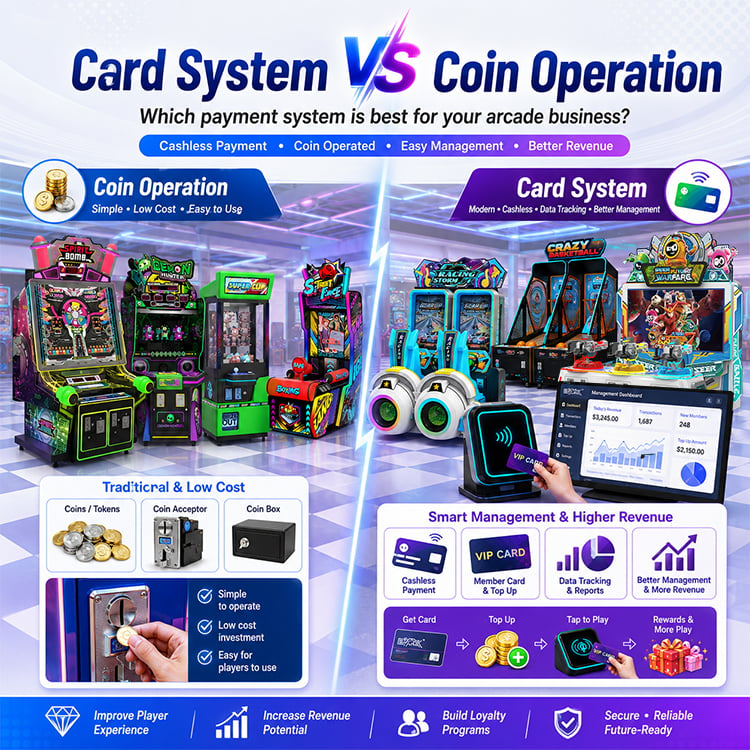
Choosing the right payment system is one of the most important decisions when opening or upgrading an arcade or Family Entertainment Center (FEC). While game selection and venue design often receive the most attention, the payment method directly affects customer experience, operational efficiency, revenue management, and long-term profitability.
Today, arcade operators typically choose between traditional coin-operated systems and cashless card systems. Coin operation has been the industry standard for decades because of its simplicity and low startup cost. Card systems, on the other hand, have become increasingly popular in modern entertainment centers thanks to their convenience, centralized management, and advanced reporting capabilities.
So, which payment system is the better choice? The answer depends on your venue size, customer demographics, budget, and future expansion plans. This guide compares both systems from a commercial buyer's perspective to help you make an informed investment decision.
How Coin-Operated Arcade Systems Work
Simple and Familiar
Coin-operated machines are straightforward. Customers insert coins or tokens into each machine to begin playing. Once payment is accepted, the game starts immediately.
This system requires minimal setup and has remained popular in small arcades, amusement parks, shopping malls, and standalone entertainment locations.
For operators launching a small business with limited capital, coin operation offers a quick and affordable solution.
Advantages of Coin Operation
- Lower initial investment
- Simple installation
- Easy for customers to understand
- No network infrastructure required
- Compatible with most commercial arcade machines
Because every machine operates independently, installation is relatively simple and technical requirements are minimal.
Limitations
As venues grow larger, coin-operated systems become more difficult to manage.
Common challenges include:
- Manual coin collection
- Cash counting errors
- Coin acceptor maintenance
- Coin jams
- Limited sales reporting
- Difficulty adjusting game prices
Without centralized software, operators have little visibility into machine performance or customer spending habits.
How Arcade Card Systems Work
Card systems replace coins with rechargeable RFID or magnetic cards.
Customers purchase or recharge a play card at a self-service kiosk or cashier. Credits are stored electronically, allowing players to simply tap or swipe their card at each game.
Every transaction is recorded by a central management system.
Instead of managing hundreds of individual coin boxes, operators monitor all machines through one platform.
Advantages of Card Systems
Modern card systems provide significant operational advantages.
Faster Customer Experience
Visitors don't need to carry pockets full of coins or tokens.
Instead, they simply recharge once and enjoy uninterrupted gameplay.
This creates a smoother customer journey, especially for families with children.
Better Revenue Management
Every transaction is automatically recorded.
Operators can easily monitor:
- Daily revenue
- Machine utilization
- Peak business hours
- Most popular games
- Customer spending patterns
This information helps improve purchasing decisions and optimize machine placement.
Flexible Promotions
Unlike coin-operated systems, card systems allow operators to launch promotions almost instantly.
Examples include:
Bonus credits
- Happy hour discounts
- Birthday rewards
- Membership programs
- VIP customer benefits
- Seasonal promotions
These marketing tools encourage repeat visits and higher customer spending.
Limitations
Despite their advantages, card systems require greater upfront investment.
Operators should budget for:
- Card readers
- Recharge kiosks
- Management software
- Server equipment
- Network installation
- Staff training
For very small venues, these costs may outweigh the operational benefits.
Card System vs Coin Operation
Feature |
Coin Operation |
Card System |
Initial Investment |
Low |
Higher |
Installation |
Simple |
More complex |
Customer Convenience |
Good |
Excellent |
Revenue Tracking |
Manual |
Real-time |
Promotions |
Limited |
Highly flexible |
Price Adjustment |
Manual |
Remote software |
Cash Handling |
High |
Minimal |
Business Data |
Very limited |
Comprehensive |
Scalability |
Moderate |
Excellent |
Which System Offers Better Cost Control?
Many buyers focus only on the purchase price.
However, the Total Cost of Ownership (TCO) is a more meaningful measure.
Initial Investment
A coin-operated setup typically includes:
- Coin acceptors
- Cash boxes
- Token systems (optional)
A card system requires additional equipment:
RFID card readers
- Recharge stations
- Central server
- Management software
- Network devices
As a result, startup costs are generally higher.
Operating Costs
Over time, coin-operated systems create ongoing labor requirements.
Staff must:
- Collect coins
- Count cash
- Refill change machines
- Resolve coin jams
- Perform manual accounting
These tasks consume valuable labor hours.
Card systems automate many of these processes, reducing daily operational workload.
Long-Term Value
Although card systems require greater initial investment, many medium and large venues recover those costs through:
- Lower labor expenses
- Better operational efficiency
- Increased customer spending
- Improved marketing capabilities
- Reduced cash handling risks
For businesses planning long-term growth, the higher upfront cost can provide stronger returns over time.
Which Payment System Improves Customer Experience?
Customer convenience plays an important role in repeat business.
Coin Operation
Many visitors still appreciate the simplicity of inserting a coin and immediately starting a game.
For tourist attractions or locations with occasional visitors, coin operation remains practical.
Card Systems
For Family Entertainment Centers, card systems create a more seamless experience.
Instead of stopping to exchange money multiple times, guests simply recharge once and continue playing.
Parents especially appreciate not needing to carry large quantities of coins while supervising children.
Encouraging Higher Spending
Research across the retail and entertainment industries shows that cashless payments often reduce purchasing friction.
Because customers focus less on each individual payment, they tend to enjoy more games before stopping.
Combined with bonus credit promotions, card systems can naturally encourage increased participation.
Which System Is Easier to Manage?
Operational efficiency becomes increasingly important as the number of machines grows.
Revenue Tracking
Coin systems rely on manual counting and spreadsheets.
Card systems generate real-time reports showing:
- Revenue by machine
- Daily transactions
- Popular attractions
- Equipment utilization
- Customer activity
This information supports better business decisions.
Pricing Flexibility
Changing game prices on coin-operated machines usually requires adjustments to each individual machine.
With a card system, operators can often update pricing across the entire venue through software in just a few minutes.
This flexibility is especially useful for:
- Weekend pricing
- Holiday promotions
- Off-peak discounts
- Special events
Security
Card systems also reduce cash-related risks.
Benefits include:
- Fewer cash transactions
- Reduced theft opportunities
- Electronic transaction records
- User access permissions
- Easier financial auditing
Which Payment System Is Best for Different Businesses?
Business Type |
Recommended System |
Small arcade (under 30 machines) |
Coin operation |
Shopping mall game zone |
Coin or token operation |
Medium Family Entertainment Center |
Basic card system |
Large FEC (50+ machines) |
Full card management system |
Multi-location arcade chain |
Centralized card system |
Theme park or indoor amusement park |
Card system with membership functions |
There is no one-size-fits-all solution. The ideal payment system depends on your operating model and long-term business goals.
Can Coin-Operated Machines Be Upgraded?
Many buyers worry that choosing coin operation today will limit future upgrades.
Fortunately, many modern commercial arcade machines are designed with upgrade flexibility in mind.
Depending on the machine model, operators can often retrofit:
- RFID card readers
- Tap-to-play modules
- Central management interfaces
Before placing an order, buyers should confirm with the manufacturer whether the machines support future card system integration and whether the required interfaces are pre-installed.
Planning ahead can reduce upgrade costs as the business expands.
Questions Buyers Should Ask Before Ordering
Before purchasing commercial arcade machines, consider asking your supplier:
- Does the machine support both coin and card operation?
- Is the card reader interface pre-installed?
- Which communication protocols are supported?
- Can game pricing be adjusted through software?
- Is the payment system compatible with ticket redemption?
- Are replacement card readers and spare parts readily available?
- What technical support is provided after installation?
- Can the system support future expansion to additional locations?
These questions help ensure that your investment remains adaptable as your business grows.
Conclusion
Both coin-operated systems and card systems have their place in today's arcade industry.
Coin operation remains a practical choice for smaller venues thanks to its affordability, simplicity, and ease of installation. Card systems, however, offer significant advantages for medium and large Family Entertainment Centers by improving operational efficiency, customer convenience, and data-driven management.
Rather than focusing only on the initial equipment cost, buyers should evaluate the complete operating model, expected customer traffic, staffing requirements, and future expansion plans. Selecting the right payment system today can improve daily operations, support business growth, and enhance the overall customer experience for years to come.
Table of Contents
- How Coin-Operated Arcade Systems Work
- How Arcade Card Systems Work
- Card System vs Coin Operation
- Which System Offers Better Cost Control?
- Which Payment System Improves Customer Experience?
- Which System Is Easier to Manage?
- Which Payment System Is Best for Different Businesses?
- Can Coin-Operated Machines Be Upgraded?
- Questions Buyers Should Ask Before Ordering
- Conclusion