
 EN
EN


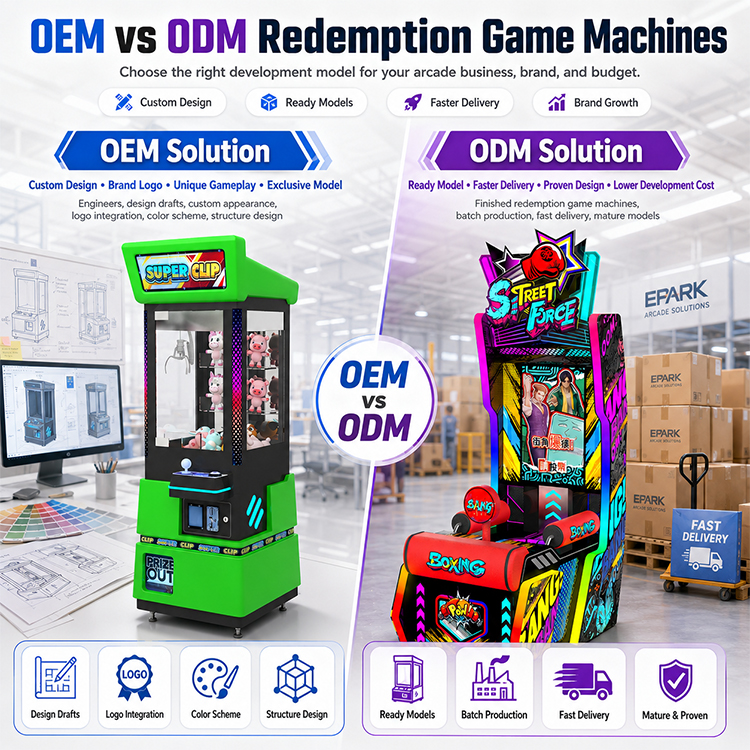
The global demand for redemption game machines continues to grow as Family Entertainment Centers (FECs), arcades, shopping malls, theme parks, and indoor entertainment venues seek attractions that encourage repeat play and increase customer engagement. For distributors, operators, and entertainment investors, selecting the right machines is only part of the purchasing process. Choosing the right manufacturing model is equally important.
Two of the most common manufacturing options are OEM (Original Equipment Manufacturer) and ODM (Original Design Manufacturer). Although these terms are widely used in the amusement industry, many buyers are unsure which option best suits their business.
Should you invest in a fully customized product that strengthens your brand, or choose a proven design that allows you to enter the market quickly with lower costs?
The answer depends on your business objectives, budget, target market, and long-term growth strategy. This guide explains the differences between OEM and ODM redemption game machines, compares their advantages and limitations, and helps you determine which manufacturing model is the right fit for your business.
What Is OEM Manufacturing?
OEM (Original Equipment Manufacturer) refers to a production model in which the buyer provides the product concept, specifications, or customization requirements, while the manufacturer is responsible for engineering, production, testing, and quality control.
In the redemption game industry, OEM projects can range from simple branding updates to completely customized cabinets, gameplay, lighting systems, software, and mechanical structures.
Instead of purchasing a standard product, buyers receive machines designed specifically for their brand or market.
Advantages of OEM Redemption Game Machines
Build a Unique Brand Identity
Exclusive products help your business stand out in a competitive market. Customized cabinet designs, artwork, lighting effects, and gameplay create a unique customer experience that competitors cannot easily copy.
Greater Product Differentiation
Distributors and brand owners often choose OEM because exclusive machines reduce direct price competition. Offering products unavailable from other suppliers increases perceived value and strengthens customer loyalty.
Flexible Customization
OEM projects typically allow customization of:
- Cabinet appearance
- Brand logo and graphics
- Game themes
- Software interfaces
- Language options
- Coin, token, or card payment systems
- LED lighting effects
- Prize payout settings
- Voltage and electrical standards
Better Intellectual Property Protection
Custom-developed products are easier to protect through trademarks, patents, copyrights, or exclusive agreements, giving businesses greater control over their product portfolio.
Challenges of OEM
While OEM offers maximum flexibility, it also requires a larger investment.
Common considerations include:
- Higher development costs
- Longer product development cycles
- Prototype testing
- Higher minimum order quantities (MOQ)
- Engineering validation
- Compliance with local certifications
OEM is generally better suited for companies with long-term business plans and stable purchasing volumes.
What Is ODM Manufacturing?
ODM (Original Design Manufacturer) is a manufacturing model where the supplier develops and owns the product design. Buyers select an existing machine and customize limited elements such as branding, cabinet colors, or artwork before selling it under their own brand.
Because the core product has already been developed and tested, ODM significantly reduces development time and investment.
For many distributors and startup operators, ODM offers the fastest path to market.
Advantages of ODM Redemption Game Machines
Faster Time to Market
Since the machine already exists, production can begin much sooner than an OEM project.
This is particularly valuable for businesses preparing for seasonal openings or expanding existing entertainment venues.
Lower Development Costs
There are no major engineering or research expenses because the manufacturer has already completed product development.
This allows buyers to invest more resources in marketing, venue expansion, or additional equipment.
Proven Product Performance
ODM products have often been installed in multiple entertainment venues, providing valuable operational feedback and performance data.
Buyers benefit from designs that have already been tested under real commercial conditions.
Lower Risk
For businesses entering a new market, choosing an existing product reduces uncertainty while allowing operators to evaluate customer demand before investing in exclusive product development.
Limitations of ODM
Although ODM provides speed and affordability, buyers should also understand its limitations.
Potential drawbacks include:
- Limited design customization
- Similar products available from multiple suppliers
- Less product exclusivity
- Reduced brand differentiation
If building a premium proprietary brand is your primary objective, OEM may offer greater long-term advantages.
OEM vs ODM: A Side-by-Side Comparison
Feature |
OEM |
ODM |
Product Design |
Customer-driven |
Manufacturer-developed |
Development Cost |
Higher |
Lower |
Time to Market |
Longer |
Faster |
Product Customization |
Extensive |
Limited |
Brand Exclusivity |
High |
Moderate |
Initial Investment |
Higher |
Lower |
Minimum Order Quantity |
Usually Higher |
Often Lower |
Product Risk |
More Development Risk |
Proven Design |
Best For |
Brand owners, distributors, large projects |
Startups, operators, fast expansion |
Which Option Is Best for Different Buyers?
Arcade Operators
Most arcade operators prioritize reliable equipment, fast delivery, and manageable investment costs.
For single-location businesses or venues expanding their game mix, ODM machines often provide the best balance between quality, affordability, and speed.
However, large entertainment chains may invest in OEM products to create exclusive attractions that distinguish their venues from competitors.
Distributors
Distributors face increasing competition in many regions.
Offering unique products can become a significant competitive advantage.
For distributors with established sales networks, OEM enables the creation of exclusive product lines that strengthen brand recognition and reduce direct price competition.
Smaller distributors entering new markets may choose ODM initially before gradually transitioning to OEM as their business grows.
Brand Owners
Companies developing their own amusement brands typically benefit most from OEM manufacturing.
Exclusive products help establish a consistent product identity while supporting long-term marketing strategies.
Customized cabinets, software, and branding create a stronger perception of professionalism and innovation.
Startup Investors
Businesses entering the amusement industry for the first time often face budget limitations and uncertain market demand.
ODM provides a practical solution by allowing startups to launch quickly with proven products while minimizing development costs.
Once the business expands and customer preferences become clearer, transitioning to OEM products becomes a logical next step.
When Should You Choose OEM?
OEM is generally the better option when your business goals include:
- Building a recognizable international brand
- Creating exclusive redemption game machines
- Developing proprietary gameplay concepts
- Protecting intellectual property
- Purchasing large production volumes
- Supporting long-term business growth
Although the initial investment is higher, OEM can generate stronger competitive advantages over time.
When Should You Choose ODM?
ODM is ideal if your priorities include:
- Entering the market quickly
- Lower startup costs
- Reduced development risk
- Expanding your product portfolio
- Testing customer demand
- Shorter lead times
For many operators and distributors, ODM offers an efficient way to grow while maintaining financial flexibility.
How EPARK Supports Both OEM and ODM Projects
As a professional manufacturer of commercial redemption game machines, EPARK provides both OEM and ODM solutions for customers worldwide.
Our engineering, design, and production teams work closely with clients to develop products that align with their business objectives, whether they require a fully customized machine or a proven ready-to-market solution.
Our OEM services include:
- Cabinet design customization
- Custom artwork and branding
- Gameplay adjustments
- Software development
- LED lighting customization
- Language localization
- Payment system integration
- Electrical standard adaptation
- Product prototyping
- Quality testing
For ODM projects, customers can choose from a wide range of commercially successful redemption game machines while customizing logos, cabinet graphics, color schemes, and branding elements.
Every machine undergoes comprehensive quality inspection before shipment to ensure reliable performance in commercial environments.
How to Decide Between OEM and ODM
Before making a purchasing decision, ask yourself the following questions:
- Do you want to build your own brand or sell proven products?
- How quickly do you need the machines?
- What is your available budget?
- Will you purchase repeatedly over the long term?
- Do you need exclusive products for your market?
- How important is product differentiation?
Your answers will help determine which manufacturing model best supports your business strategy.
Conclusion
There is no universal answer to whether OEM or ODM is better. The right choice depends entirely on your business goals.
If your priority is speed, lower investment, and reduced development risk, ODM provides an efficient solution with proven products ready for market.
If your goal is to build a distinctive brand, develop exclusive products, and create long-term competitive advantages, OEM offers greater flexibility and stronger differentiation.
Many successful amusement businesses begin with ODM products to establish their presence before gradually investing in OEM development as their brand grows.
By understanding the strengths of both manufacturing models, you can make informed purchasing decisions that support sustainable business growth and deliver greater value to your customers.
FAQ
1. What does OEM mean in the amusement industry?
OEM (Original Equipment Manufacturer) refers to products manufactured according to a customer's custom design, specifications, or branding requirements.
2. What is ODM manufacturing?
ODM (Original Design Manufacturer) means the manufacturer develops the product, while customers customize branding, colors, or other limited features before selling it under their own brand.
3. Which is more affordable, OEM or ODM?
ODM is generally more cost-effective because product development has already been completed.
4. Can I customize an ODM redemption game machine?
Yes. Most manufacturers allow customization of logos, cabinet artwork, colors, and branding, although core gameplay and structure usually remain unchanged.
5. Who should choose OEM manufacturing?
OEM is best suited for established brands, distributors, and businesses seeking exclusive products and long-term market differentiation.
6. Is ODM suitable for startup businesses?
Yes. ODM allows startups to enter the market quickly with lower investment and reduced development risk.
7. Does EPARK provide both OEM and ODM services?
Yes. EPARK offers comprehensive OEM and ODM manufacturing solutions, including design, production, quality control, and global export support.
8. How do I choose the right manufacturing model?
Evaluate your budget, timeline, branding goals, expected order volume, and long-term business strategy before deciding between OEM and ODM.