
 EN
EN


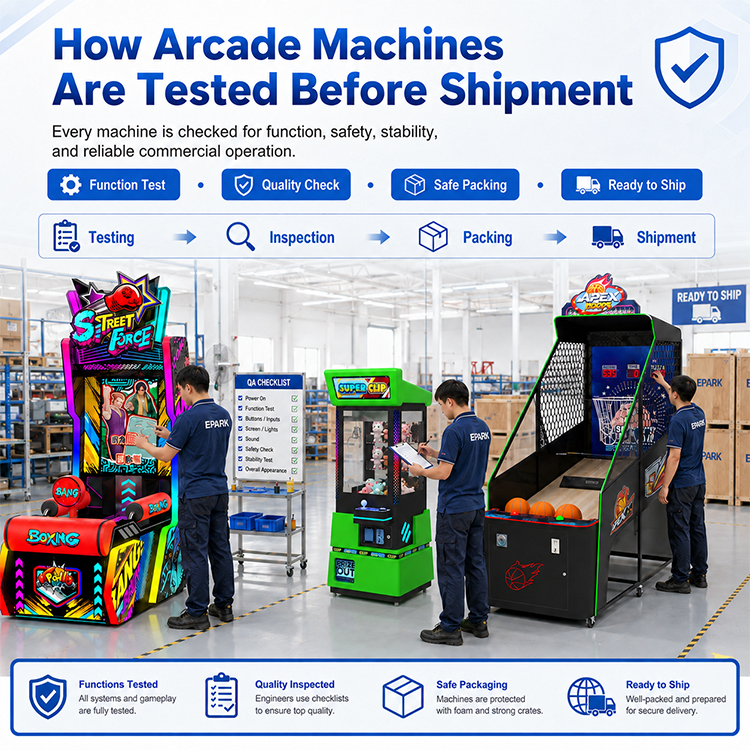
When an arcade machine leaves a factory, the manufacturing process is not necessarily finished. Assembly is only one part of the job. Before a commercial arcade machine is packed and shipped to an overseas customer, it typically needs to go through a series of inspections and functional tests.
This process is especially important for international buyers. An arcade machine may travel thousands of kilometers before reaching an arcade, Family Entertainment Center, shopping mall, or other entertainment venue. If a problem is discovered after installation, troubleshooting can take significantly more time than identifying the issue before shipment.
For this reason, professional arcade machine manufacturers use pre-shipment testing to check electrical systems, controls, displays, sound, lighting, payment functions, software, cabinet construction, and other components.
A machine should not simply look finished.
It should be ready for commercial operation.
Why Factory Testing Matters for Arcade Machine Buyers
Commercial arcade machines are designed for repeated use. Unlike equipment intended for occasional home entertainment, machines installed in arcades and FECs may operate for many hours every day.
That means reliability matters.
A loose connection, unresponsive button, unstable screen, defective sensor, or incorrectly configured payment system can affect the player experience and create additional maintenance work for the operator.
Factory testing allows manufacturers to identify these problems before the equipment reaches the customer.
For international buyers, this is particularly valuable. Once a machine has been exported, resolving a technical issue may involve remote troubleshooting, replacement parts, or additional shipping. Testing at the factory provides an opportunity to address problems while the machine and production team are still in the same location.
The Main Stages of Arcade Machine Testing
Although testing procedures vary by manufacturer and product type, a typical commercial arcade machine may go through a process similar to this:
Assembly → Electrical Inspection → Power-On Test → Gameplay Test → Functional Test → Burn-In Test → Appearance Inspection → Final QC → Packing
Different arcade machines require different testing procedures. A racing simulator, claw machine, basketball game, and VR simulator do not have identical components.
However, the basic principle remains the same: test the complete machine, not just individual parts.
Electrical and Power Testing
Electrical testing is one of the first important checks after assembly.
Technicians verify that internal wiring and electrical components have been installed correctly. Power supplies, switches, connectors, fuses, lighting systems, and other electrical elements may be inspected before the machine enters final testing.
Voltage compatibility is particularly important for export orders.
Different markets can use different voltage and plug configurations. A manufacturer should therefore confirm the electrical requirements specified for the destination market before production and shipment.
A machine that works correctly under the wrong electrical configuration is still not ready for export.
The goal is stable and appropriate operation under the customer's specified conditions.
Gameplay and Control Testing
The next step is testing the components that players actually interact with.
Depending on the machine, this may include:
- Joysticks
- Buttons
- Steering wheels
- Pedals
- Shooting guns
- Touchscreens
- Motion sensors
- Card readers
- Ticket dispensers
- Other interactive controls
Technicians need to verify more than whether a component turns on.
For example, a steering wheel should respond smoothly throughout its range. A button should register consistently. A shooting sensor should detect player input correctly. A touchscreen should respond to touches without noticeable dead areas.
These details directly influence gameplay.
A machine can have attractive graphics and a powerful cabinet, but if the controls feel unreliable, players will notice immediately.
Screen, Audio, and Lighting Tests
Visual and audio components are another important part of the pre-shipment inspection.
Technicians may check whether the display starts correctly, whether the image is stable, and whether the screen produces the expected visual output.
For touchscreen products, touch response also needs to be checked.
Audio testing can include speakers, volume controls, sound effects, and game music. Decorative lighting and LED effects are also inspected where applicable.
These elements may appear secondary from a manufacturing perspective, but they have a major influence on the perceived quality of an arcade machine.
A dark LED panel or distorted speaker can make an otherwise functional machine look unfinished.
Payment and Game Management System Testing
Modern arcade machines can use different payment and management systems.
Depending on the model and market, a machine may support:
- Coins
- Tokens
- Card readers
- QR payment
- Digital credits
- Ticket systems
- Centralized game management
These functions should be tested before shipment when they are included in the project.
For example, technicians may verify whether credits are correctly registered after payment, whether the game starts correctly, and whether ticket or prize-related functions work as configured.
This becomes even more important for customized projects.
If a buyer requests a specific payment system or regional configuration, the manufacturer should confirm compatibility during production rather than leaving the issue until installation.
Burn-In Testing: Why Running the Machine Matters
One of the most useful parts of quality control is burn-in testing.
A machine that powers on successfully for five minutes is not necessarily ready for commercial operation.
Burn-in testing involves operating the machine for an extended period to help identify potential intermittent problems. Depending on the product, technicians may monitor system stability, temperature, controls, displays, sound, and other functions during operation.
The purpose is simple:
Find problems before the customer does.
This can be particularly valuable for machines containing multiple electronic components, displays, motors, lighting systems, or motion mechanisms.
The exact duration and procedure can vary according to the product and manufacturer's quality-control process. There is no universal burn-in period that applies to every arcade machine.
Appearance and Cabinet Inspection
Functionality is not the only consideration.
The exterior of an arcade machine also needs to be inspected before shipment.
Quality-control staff may check:
- Cabinet surfaces
- Paintwork
- Printed graphics
- Acrylic panels
- Metal components
- Screws and fasteners
- Doors and locks
- Branding
- Protective film
- Overall assembly
This is particularly important for machines installed in customer-facing environments.
A cabinet with scratches, loose panels, damaged artwork, or missing hardware can create a poor first impression even if the game itself works perfectly.
For customized arcade machines, the inspection may also include checking logos, artwork, colors, language, and other customer-specific details.
Final Quality Control Before Packing
Before packing, the machine should go through a final inspection.
A practical checklist may look like this:
| Inspection Area | What Is Checked |
|---|---|
| Electrical | Power, wiring, switches, connectors |
| Gameplay | Controls and game functions |
| Display | Screen and visual output |
| Audio | Speakers and sound effects |
| Lighting | LEDs and decorative effects |
| Payment | Coin, card, or QR functions |
| Cabinet | Assembly, graphics, and appearance |
| Accessories | Cables, manuals, and spare parts |
| Packaging | Protection and shipping preparation |
This final step helps confirm that the machine is complete and corresponds with the customer's order.
For larger projects involving multiple machines, serial numbers, accessories, and customized specifications should also be checked against the order documentation.
How Arcade Machines Are Prepared for International Shipment
Quality control does not end when the machine passes its functional test.
International transportation creates additional risks. Arcade machines may be moved between factories, warehouses, ports, containers, and final destinations before installation.
Manufacturers therefore need to consider packaging and transport protection.
Depending on the machine, preparation may include protective film, foam, corner protection, reinforced cartons, wooden cases, moisture protection, and separate packaging for accessories.
Some machines may also need partial disassembly to make transportation more efficient or reduce the risk of damage.
The objective is straightforward:
Protect the machine after it has passed the factory test.
A perfectly tested machine can still arrive damaged if it is not packaged appropriately for its shipping environment.
What Buyers Should Ask Their Arcade Machine Manufacturer
Before placing a commercial arcade machine order, buyers should understand how the supplier handles quality control.
Here are several useful questions:
- Is every machine tested before shipment?
- What functions are included in the final inspection?
- Is burn-in testing performed?
- Can the manufacturer provide testing photos or videos?
- Are payment systems tested before delivery?
- What spare parts are included with the shipment?
- How are customized specifications verified?
- What type of export packaging is used?
- What happens if a technical problem is discovered after delivery?
- Is remote technical support available?
These questions do not simply evaluate the product.
They evaluate the manufacturer's process.
For B2B buyers, that distinction is important.
Why Customized Arcade Machines Require More Testing
OEM and ODM projects introduce additional variables into production.
A standard arcade machine may already have established electrical configurations, software settings, cabinet artwork, and payment options. A customized machine can involve changes to several of these areas.
For example, a buyer may request:
- Custom cabinet artwork
- Private-label branding
- Different voltage requirements
- Local language settings
- Specific payment systems
- Customized game settings
- Regional plug standards
Each additional customization creates another item that needs to be verified.
This is why buyers should not evaluate an OEM supplier solely by whether it can produce a customized cabinet.
The more important question is whether the manufacturer has a repeatable process for checking customized products before shipment.
Why Factory Quality Control Builds Supplier Trust
For B2B buyers, factory testing is also an indicator of manufacturing capability.
A professional supplier should have a clear process for moving products from assembly to inspection and finally to shipment.
Transparent quality-control procedures can demonstrate attention to detail, production discipline, and responsibility toward international customers.
This does not mean that testing guarantees that a machine will never experience a problem. Commercial equipment contains electronic, mechanical, and software components, and unexpected issues can still occur.
However, systematic testing can reduce avoidable problems and provide a stronger foundation for after-sales service.
For buyers purchasing multiple machines, this becomes even more important.
Consistency matters.
How EPARK Approaches Arcade Machine Quality Control
For an arcade machine manufacturer, quality control needs to be integrated into the production process rather than treated as a final formality.
At EPARK, arcade machines can be inspected across key stages including assembly, electrical systems, gameplay functions, audiovisual components, cabinet appearance, and final packing preparation.
For customized and export projects, product specifications should also be checked against the buyer's requirements before shipment.
This approach is particularly relevant for distributors, arcade operators, FEC projects, and international buyers purchasing commercial equipment in volume.
The objective is not simply to deliver a machine that powers on.
It is to deliver equipment that is properly configured and prepared for its intended commercial environment.
Conclusion
The journey of an arcade machine does not end when the cabinet has been assembled.
Before shipment, a commercial machine should go through multiple stages of inspection. Electrical systems need to be checked. Controls and gameplay functions need to respond correctly. Screens, audio, lighting, and payment systems need to work as expected. Where appropriate, burn-in testing can help identify stability issues, while final appearance and packaging inspections help prepare the machine for international transportation.
For buyers, understanding this process provides a useful way to evaluate arcade machine manufacturers.
The right question is not simply:
“How much does the machine cost?”
It is also:
“What happens before the machine leaves the factory?”
A strong pre-shipment quality-control process can make the difference between a machine that merely looks ready and one that has been properly prepared for commercial operation.
If you are sourcing commercial arcade machines for an arcade, FEC, shopping mall, or entertainment project, working with a manufacturer that can clearly explain its testing, customization, quality-control, and export processes can help reduce purchasing risk and support a smoother installation.
Table of Contents
- Why Factory Testing Matters for Arcade Machine Buyers
- The Main Stages of Arcade Machine Testing
- Electrical and Power Testing
- Gameplay and Control Testing
- Screen, Audio, and Lighting Tests
- Payment and Game Management System Testing
- Burn-In Testing: Why Running the Machine Matters
- Appearance and Cabinet Inspection
- Final Quality Control Before Packing
- How Arcade Machines Are Prepared for International Shipment
- What Buyers Should Ask Their Arcade Machine Manufacturer
- Why Customized Arcade Machines Require More Testing
- Why Factory Quality Control Builds Supplier Trust
- How EPARK Approaches Arcade Machine Quality Control
- Conclusion